Low-Load: Art & Design that Quiets the Brain
by Ari Peralta
Inspired by the immersive spatial design of James Turrell, this article explores the sensory neuroscience behind how stripping away visual coordinates drops cognitive friction to quiet the brain.
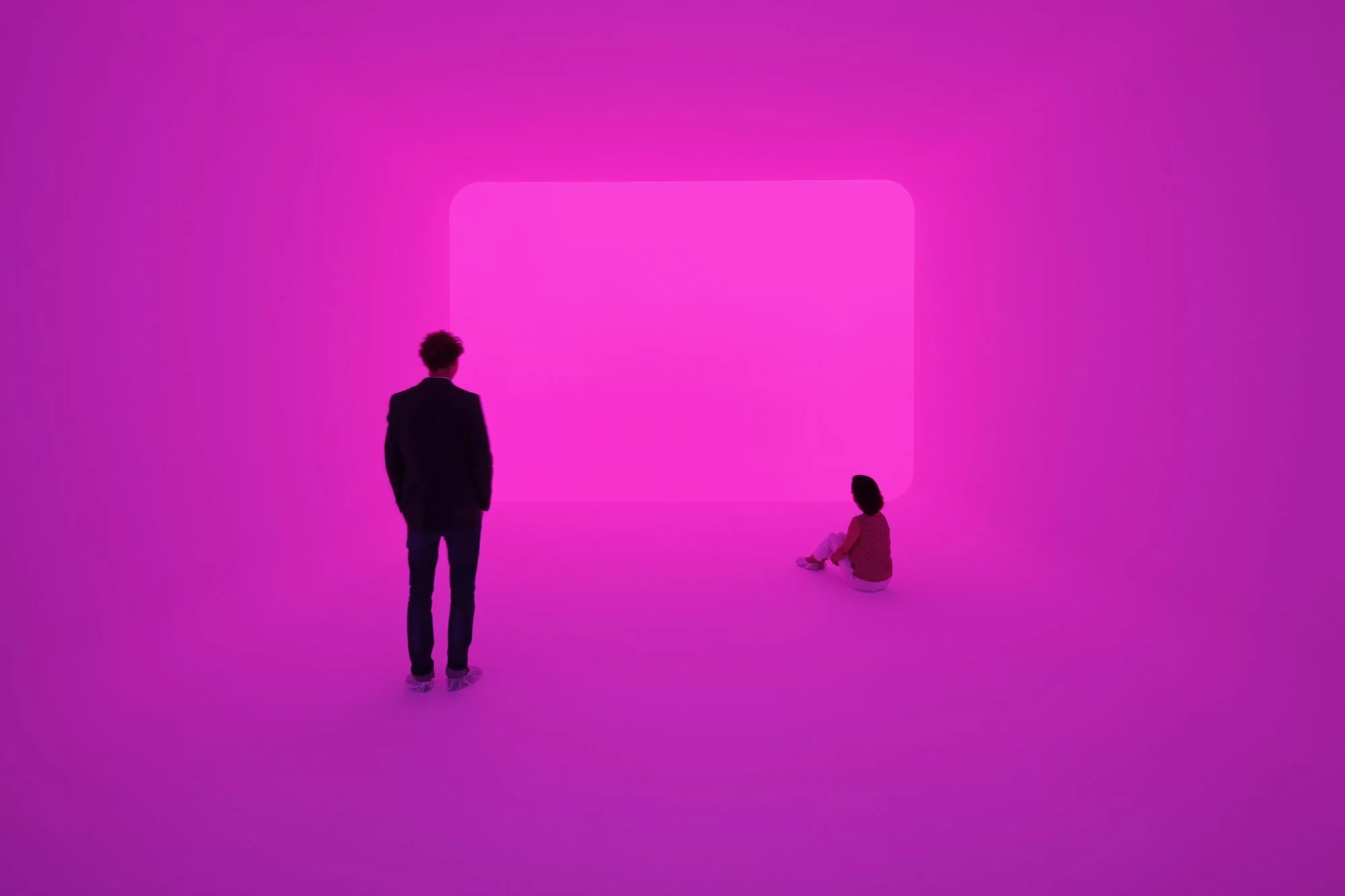
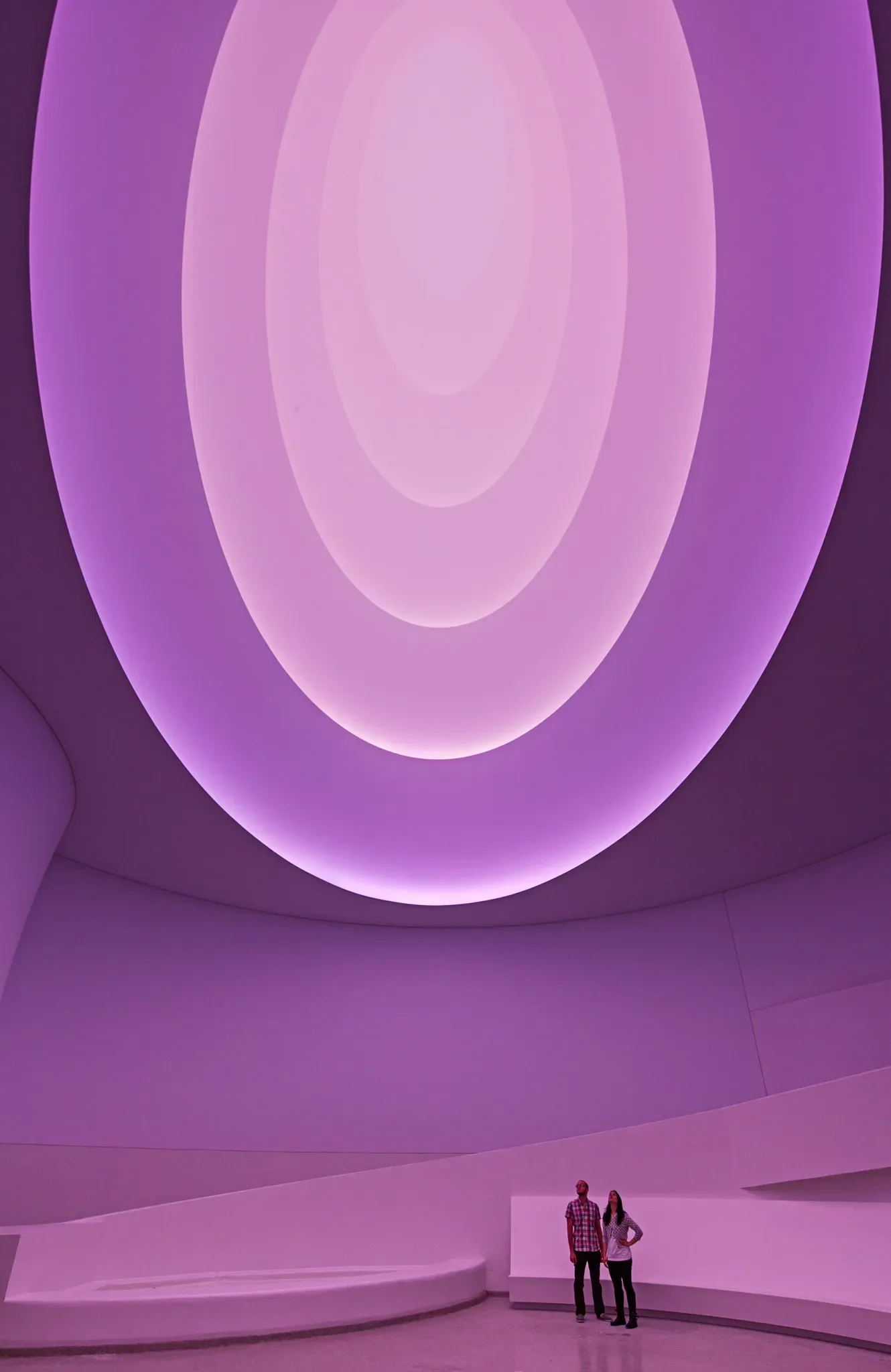
Decades into his legacy, Turrell’s work continues to captivate us—not because of what we see, but because of how it makes us feel.
In a world constantly competing for our attention, Turrell’s installations act as a psychological haven. Throughout the years I have observed that people do not merely look at his art; they rest inside it.
Turrell demonstrates that architecture can transcend physical containment to become a gentle, stabilizing vessel for human wellness design.
Several of today’s wellness interiors are saturated with kinetic media facades, ambient notification chimes, hyper-segmented spatial layouts and digital interfaces at every corner.
This is what I refer to as "always on" state of human consciousness.
This approach assumes that human attention is an infinite resource to be mined, bombarding the nervous system with an unceasing influx of task-irrelevant stimuli that forces the brain’s ventral visual pathway and predictive processing models into a loop of hyper-vigilance.
In my experience, designers tend to rely on sensory acceleration and high cognitive load over neurological rest, leaving the modern mind structurally overstimulated and starved for spaces of genuine serenity.
When an environment forces the brain to expend constant energy decoding clutter, navigating chaotic layouts, or enduring sensory overstimulation, it spikes cortisol levels and triggers executive fatigue—effectively draining the occupant instead of supporting them. Cognitive load refers to the total amount of mental effort and working memory resources required to process information and navigate an environment at any given moment.
Dimensions of Cognitive Load in Spatial Design
Intrinsic Load (The Baseline Task)
This is the inherent effort required to understand a space or perform an action within it. For example, finding the entrance of a building or figuring out how to open a door. Good design lowers this by making spaces intuitive and instantly legible.
Extraneous Load (The Environmental Noise)
This is the wasted mental energy caused by the way information or space is presented. Visual clutter, harsh fluorescent lighting, ambient noise, and conflicting geometric angles force the brain’s ventral visual pathway to work overtime to categorize and dismiss task-irrelevant stimuli.
Germane Load (The Processing & Integration)
This is the productive mental work that allows us to form mental maps, reflect, and emotionally connect with a space. Minimizing extraneous noise frees up the brain's capacity for germane processing, triggering the Default Mode Network (DMN)—the neural system responsible for introspection, daydreaming, and deep psychological calm.
High-Load Environments
High-load environments bombard the human sensory system with dense visual clutter, intense colors, and chaotic architecture. Because our brains are evolutionarily hardwired to scan surroundings for survival, chaos forces the visual cortex into a persistent loop of processing useless distractions.
Neuroscience research from Yale University demonstrates that visual clutter fundamentally alters how information flows through the brain, forcing it to work in overdrive to filter competing data. This exhaust executive function and reduces working memory.
Physiologically, a landmark study by UCLA’s Center on Everyday Lives and Families (CELF) found that individuals in cluttered spaces experience sustained spikes in the stress hormone cortisol.
Overly complex environments lock the nervous system into a chronic fight-or-flight response, driving burnout and mental fatigue.
Low-Load Spaces
In contrast, low-load spaces support neurological recovery by systematically eliminating distracting, task-irrelevant stimuli. By stripping away sharp edges, complex forms, and distinct focal points, low-load design lowers visual demands.
According to Perceptual Load Theory, our limited working memory is easily overwhelmed by high environmental data; removing these demands instantly frees up cognitive processing power.
Clinical insights highlighted by Nuvance Health confirm that clutter-free, highly balanced environments significantly lower cognitive load, enhance focus, and trigger an immediate visual reset. When an environment stops demanding active processing, the brain suppresses cortical arousal and engages the Default Mode Network (DMN).
This localized sensory rest state triggers a cascade of physiological benefits, including dropped cortisol production, lower blood pressure, and a return to psychological balance.
Ultimately, designing for the human nervous system requires a profound shift from sensory acceleration to radical subtraction. By understanding the neuroscience of cognitive load, we can stop treating physical environments as passive containers and start utilizing them as active therapeutic tools.
What can designers learn
James Turrell?
Use of Saturated Monochromatic Colors
Dissolving Forms & Hidden Shapes
Expansive Spatial Ratios
By studying Turrell’s precise approach to environmental manipulation, designers can unlock the principles behind creating genuinely restorative, low-load spaces that calm the overstimulated modern mind.
Color
Our visual system is evolutionarily hardwired to detect contrast, shifting borders, and sudden changes in illumination. When a space is flooded with a single, highly saturated, monochromatic hue, it induces a phenomenon known as neural adaptation or chromatic adaptation.
Because the entire visual field shares the same wavelength, the photoreceptors in the retina stabilize their firing rates, and the brain stops expending energy calculating color boundaries. Introducing slow, imperceptible color transitions (such as shifting from a deep indigo to a soft amber) prevents sensory deprivation while maintaining a state of low cortical arousal. By democratizing the visual plane, monochromatic saturation effectively mutes the brain's internal contrast-detection alarms, dropping cognitive fatigue.
Form
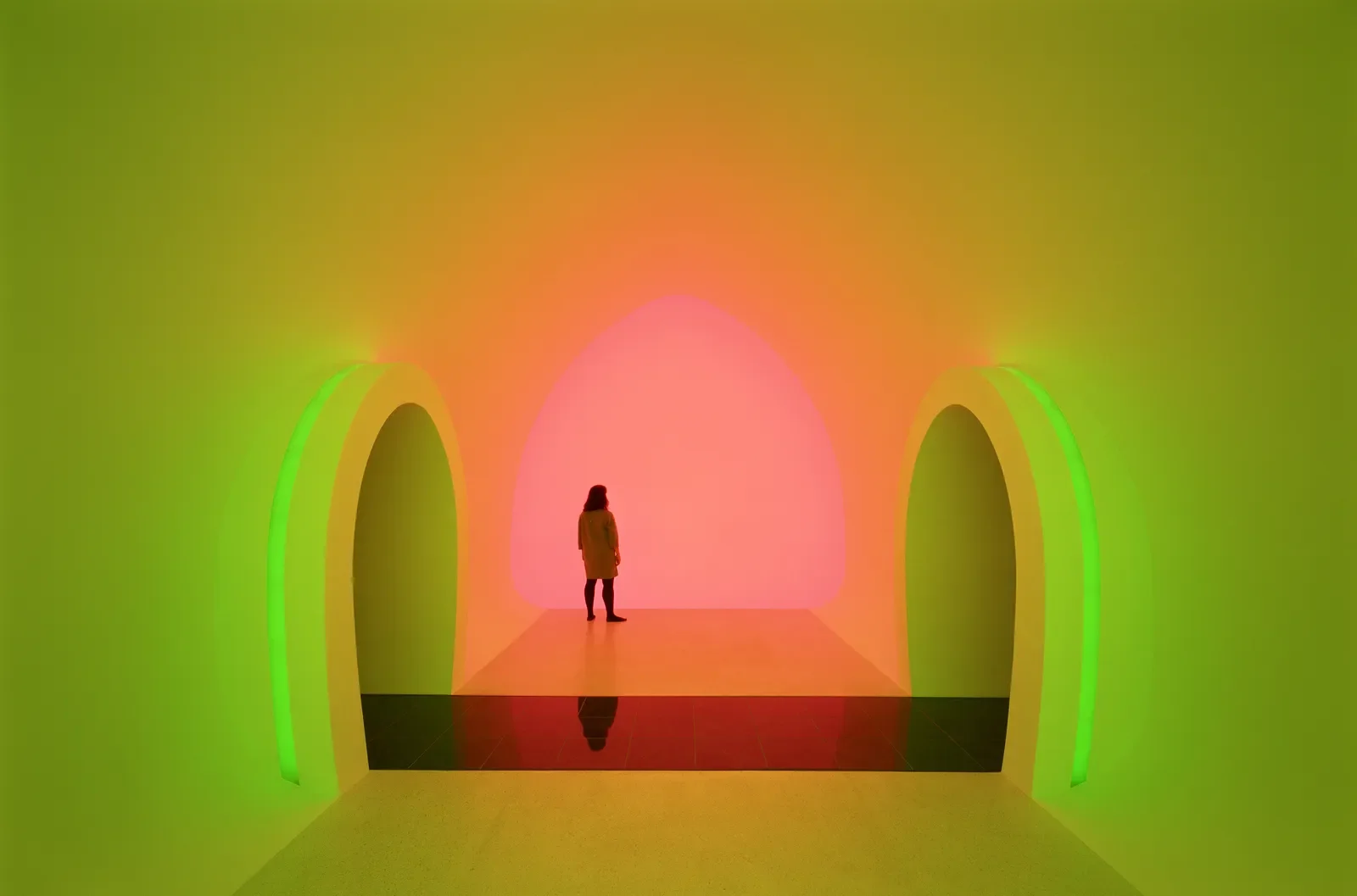
Every sharp corner, distinct shadow, or focal object in a room acts as a task-irrelevant stimulus that the brain's ventral visual pathway automatically attempts to identify, categorize, and map in space. Turrell eliminates these micro-stressors by curving architectural junctions and hiding light sources, effectively dissolving corners and structural seams.
Without hard lines or distinct targets, the brain cannot calculate precise depth or fixate on specific objects. This triggers a localized Ganzfeld effect, where the visual cortex enters a resting state due to the complete lack of structural information. By removing the need to constantly categorize surroundings, the nervous system stops actively predicting threat or processing environmental chaos, shifting mental energy from external parsing to internal calm.
Spatial Ratios
Traditional interior architecture relies on predictable, enclosed boundaries that reinforce a sense of confinement. Turrell manipulates spatial ratios by using precision-engineered apertures, false horizons, and back-lit planes to make walls and ceilings appear to recede or vanish entirely.
When structural edges are visually removed, the brain loses its physical anchors and perceives an illusion of infinite, unbounded depth. This spatial expansion prevents the claustrophobic neural responses often triggered by tight, cluttered environments. By altering the perceived ratio between the viewer and the room, the architecture opens up, signaling absolute safety and environmental stability to the primitive brain, which allows the overstimulated mind to fully exhale.

Meet James Turrell
We can apply three design principles from Turrell to curate spaces that calm:
Saturated, Monochromatic Color: Flooding a room with continuous, slow-shifting hues democratizes visual input. The eye adapts quickly to unchanging color, causing cognitive fatigue to fade.
Dissolved Forms and Hidden Shapes: Eliminating distinct focal objects or corners prevents the brain from wasting energy categorizing visual targets.
Expansive Spatial Ratios: Removing traditional structural edges creates an illusion of infinite, unbounded depth.
Tying these elements together teaches us that calming design is not about what we add, but what we subtractionally withhold. By stripping away complex visual coordinates, we allow the overstimulated mind to fully exhale.